



Recent consumer-focused PE vintages have a ways to go
Consumer spending has been on the rise, but private equity managers of youthful consumer-focused funds still have a ways to go when it comes to either increasing overall value or realizing gains. The median fund of the 2010 vintage, for example, has a total-value-to-paid-in (TVPI) multiple of 1.33x, with 0.30x for the multiple of what has been actually distributed back to limited partners (DPI). Returns data is as of the end of 2015, per normal reporting cycles, which further illustrates how funds from 2010 should be entering a period of greater realization sooner rather than later.
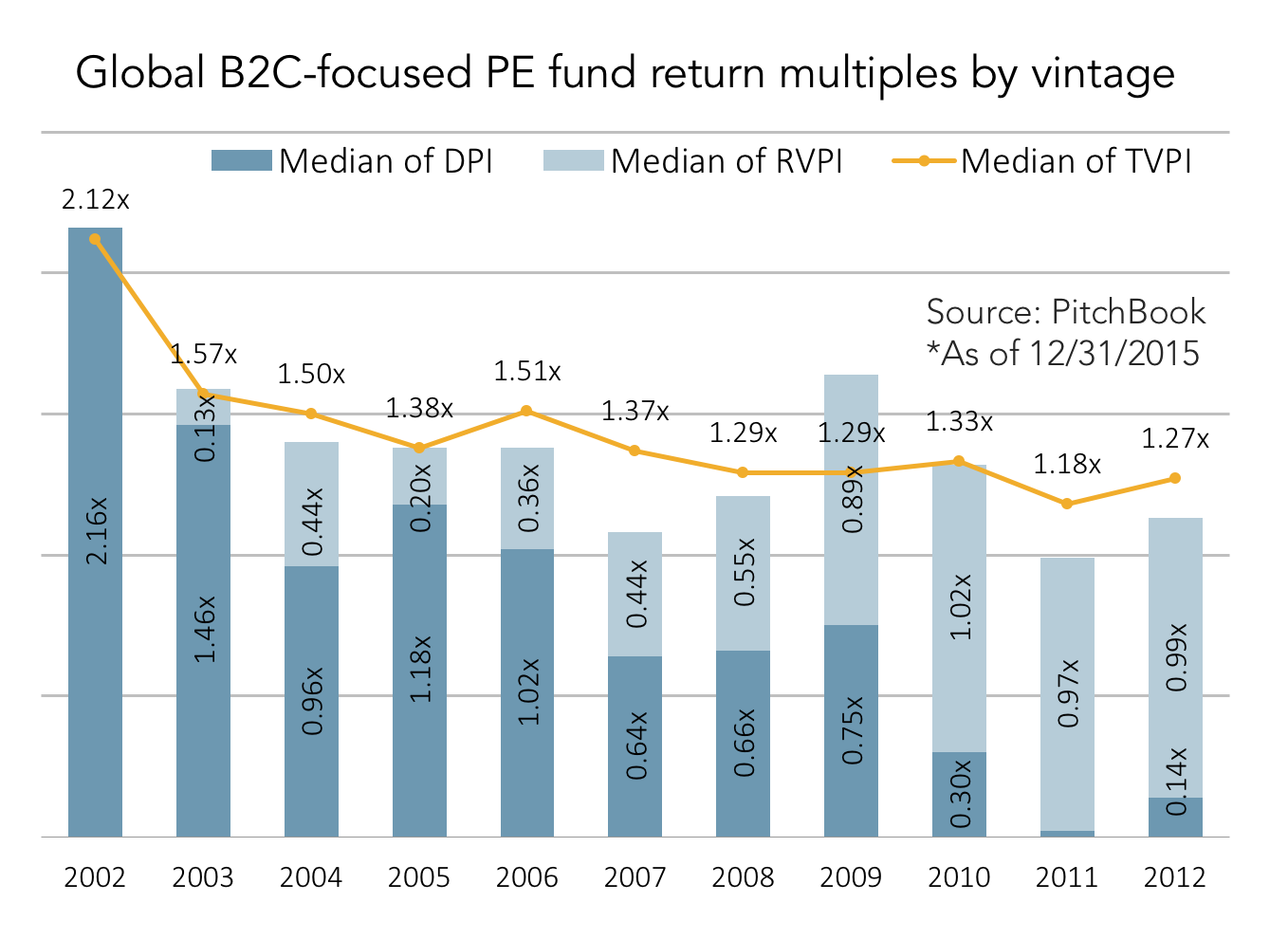
Granted, the PE industry’s typical fund life has been extending as of late, but it’s worth noting the phenomenon. Vintages closer to the recession understandably may take even longer to translate paper gains into reality. In addition, it’s not necessarily just the economic impact of the slowdown, but rather the shifting landscape of the consumer industry in general that is potentially prolonging PE managers’ efforts. Certain strategies have been able to capitalize early on the fast-casual space, but others in more traditional restaurant areas have not been quite as fortunate. In addition, niche or low-cost retail businesses have avoided—to at least some extent—the troubles faced by giants such as Nordstrom. It’s not just about adapting to millennials’ experience-based tastes, but also blending e-commerce with brick-and-mortar and keeping supply costs low while investing in more sustainable product sourcing. In short, PE fund managers of recent vintages have their work cut out for them still.
☞ Read PitchBook’s Benchmarking Report here.
Contact: Garrett Black
garrett.black@pitchbook.com


Latest news

Share of PE middle-market deal count by backing type
Add-ons remain the workhorse for middle-market deployment, accounting for 67. 1% of all middle-market transactions YTD, in line with activity seen in recent years.

Software deal share falls in middle markets, rises in large caps
In Q3’26 software’s share of total deals fell in both the Lower Middle Market (to 7%) and Upper Middle Market (to 9%), while Large Cap saw a modest uptick in share to 8%.

Secondary loan prices stabilize following steep declines
Secondary loan prices came under significant pressure through September and October, with the Bloomberg U.S. Leveraged Loan Index declining 119…