



Download PitchBook’s Report here.
Activists, shareholders and corporate boards are all increasingly vocal about focusing on core investments, which often translates into selling off non-core assets. Not every PEG is experienced in carveouts, which are riskier and more challenging than standard buyouts. But for investors who have done them in the past, the current market is presenting more opportunities than usual to buy “orphans” and form standalone businesses. Corporate sellers are taking into account after-tax savings stemming from the 2017 tax cuts. The 35% to 21% corporate tax rate reduction means, among other things, larger cash infusions from any non-core sales going forward. Would-be sellers have plenty of PE buyers at the ready, who have a mountain of dry powder to put to use. That explains a notable trend unearthed by EY’s 2018 Global Divestment Study—71% of their respondents who recently made a major divestment said the sales were prompted by “opportunistic, unsolicited” offers, up from 20% in 2014. A good chunk of those would be from PE investors.
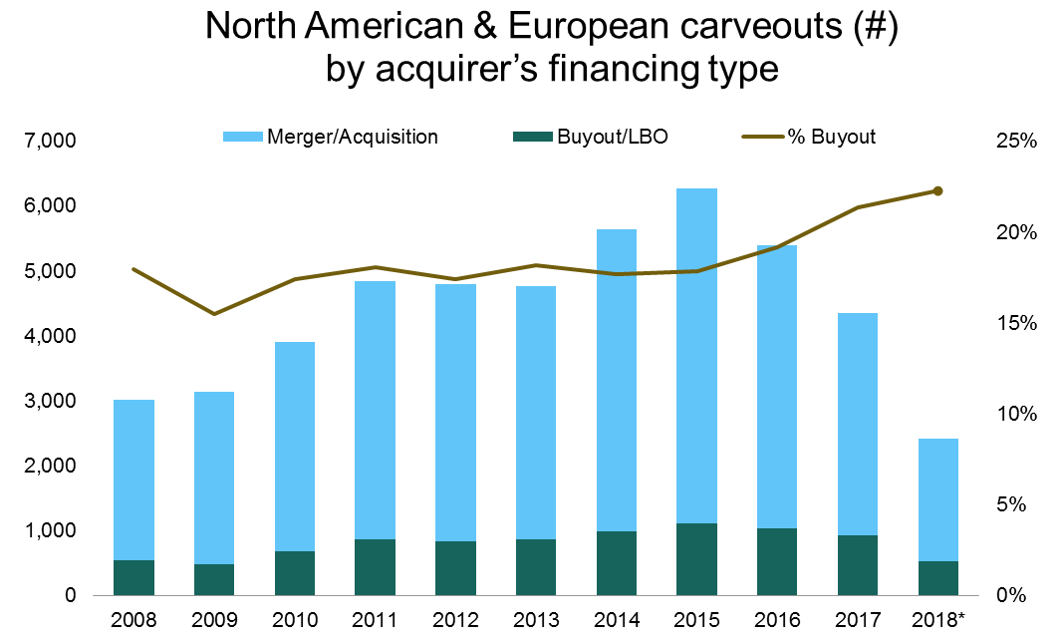
Our recent M&A Report shows a similar trend. The percentage of carveouts being done by buyout firms is rising, in part due to a slowdown in strategic-led carveouts. That makes sense. Strategics can be both buyers and sellers, but as industries consolidate and companies look to become more efficient, it makes less sense to pick up assets that don’t fit in well with a competitor. Why would those assets be a better fit in a similar company? Buyout firms are often the better choice, as long as standalone EBITDA assumptions are reasonable. PE firms with carveout experience have improved their skills over time, and some now have playbooks to rely upon going forward. With so much uncertainty at the moment, we may see a strong showing for PE-led carveouts over the near-term.
Contact: Alex Lykken
alex.lykken@pitchbook.com


Latest news

Share of PE middle-market deal count by backing type
Add-ons remain the workhorse for middle-market deployment, accounting for 67. 1% of all middle-market transactions YTD, in line with activity seen in recent years.

Software deal share falls in middle markets, rises in large caps
In Q3’26 software’s share of total deals fell in both the Lower Middle Market (to 7%) and Upper Middle Market (to 9%), while Large Cap saw a modest uptick in share to 8%.

Secondary loan prices stabilize following steep declines
Secondary loan prices came under significant pressure through September and October, with the Bloomberg U.S. Leveraged Loan Index declining 119…