



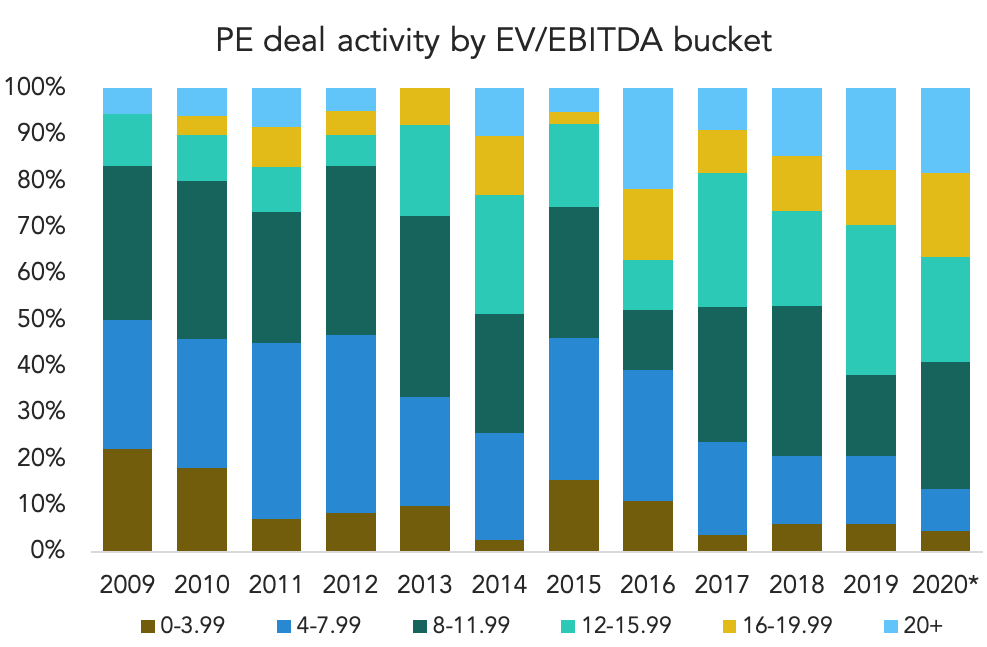
A bold prediction coming from our upcoming PE Outlook note: 20% of buyouts will be priced above 20x EBITDA. Our numbers suggest around 18% of them are trading above the 20x mark through late November, though there are caveats galore when looking at 2020 activity. Many of the companies that have come to market have either been unaffected by the COVID fallout, or have benefitted from it. Technology deals have been prominent this year, and many software companies were already trading in the high double-digits before the pandemic. Those transactions naturally boost the overall EBITDA number, while the companies that don’t come to market, because their valuations would be too low to consider, are not weighing down the headline number.
Growth-stage technology companies are one of two major factors our analysts are taking into account. Almost all aspects of the digital economy have accelerated this year, and many of these tech companies have seen their bottom lines improve under quarantine. We’ve already seen this happen for public tech companies, which are surging. Which brings us to the second major rationale for our prediction: The S&P 500 now trades at a cyclically adjusted price-to-earnings ratio (CAPE) of 33.071 due to a plethora of factors including monetary easing, widespread risk-on appetite, and the emergence of large growth-oriented companies that trade at high multiples of revenue, let alone earnings. Price multiples in both public and private markets have been elevated for some time, and we don’t see many reasons for this to change in 2021.
All that said, if the world quickly goes back to normal next year, there’s a strong chance we’ll see multiples compress for the companies that have benefitted from the lockdowns, and 20% above 20x would be a reach. There’s also the possibility that the health crisis will drag on or worsen, not only hampering the broader economy but also PE’s appetite for riskier assets going forward.


Latest news

Share of PE middle-market deal count by backing type
Add-ons remain the workhorse for middle-market deployment, accounting for 67. 1% of all middle-market transactions YTD, in line with activity seen in recent years.

Software deal share falls in middle markets, rises in large caps
In Q3’26 software’s share of total deals fell in both the Lower Middle Market (to 7%) and Upper Middle Market (to 9%), while Large Cap saw a modest uptick in share to 8%.

Secondary loan prices stabilize following steep declines
Secondary loan prices came under significant pressure through September and October, with the Bloomberg U.S. Leveraged Loan Index declining 119…