



Download PitchBook’s Report here.
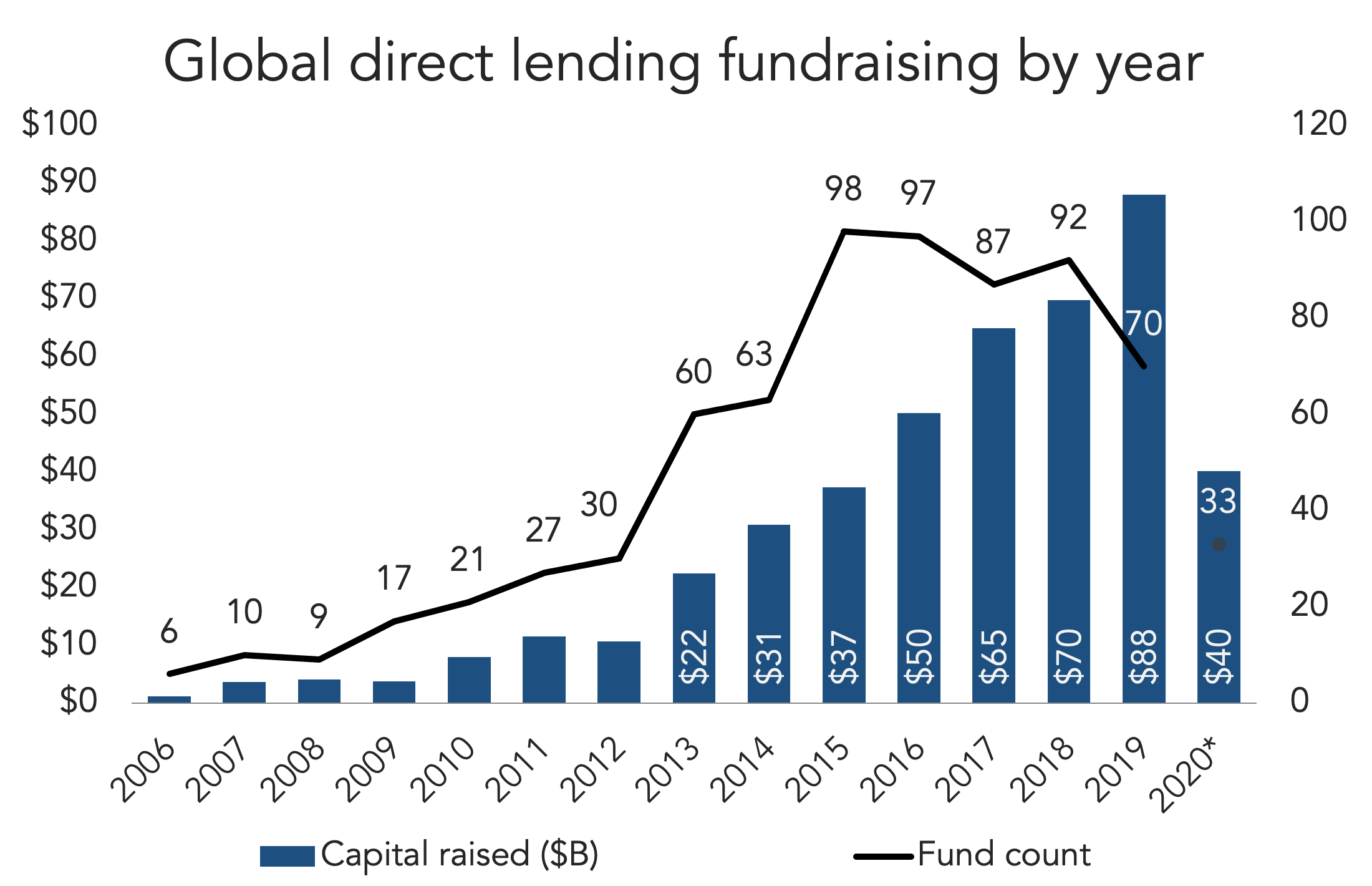
Fundraising for direct lending vehicles hit a five-year low in 2020, according to PitchBook’s latest Global Private Debt Report. The five-year angle is for dollars raised; in terms of fund closings, the 33 that wrapped up last year were the fewest since 2012, and less than half of the funds raised in 2019. The discrepancy, if we can call it that, between funds raised and capital raised exemplified a premium on larger funds compared to the past. Among the direct lending funds that did close last year, six of them raised at least $2 billion apiece, including Apollo, Antares, Blue Ocean and Churchill Asset Management in New York, and GSO and Ardian in London.
While the fundraising numbers were down, direct lenders continued to finance big deals. History was made in June for a deal involving The Ardonagh Group, a UK insurance broker, which was financed by the largest ever unitranche financing of £1.875 billion. ThyssenKrupp, the elevator maker, was acquired by a PE consortium in July for €17.2 billion. Reuters reported at the time that the €10.3 billion debt financing “raised over €20 billion in investor orders, enabling arrangers to optimize the capital structure, tighten pricing and stay within the flex to make full fees, allaying any fears over selling such a large deal during the Covid-19 pandemic.” Baird noted that “through the summer, the direct lending market remained more accessible for M&A financings than the public leveraged finance markets,” and often “prioritized financing add-on acquisitions” in particular. So while the fundraising trail got less crowded—along with everything else—appetite for deal flow kept steady. Granted, some of the biggest financings went to sectors that were more resilient to Covid-19, but they were also resilient to the slowdown in deal flow in general. That bodes well for future LP conversations and 2021 fundraising numbers.


Latest news

Share of PE middle-market deal count by backing type
Add-ons remain the workhorse for middle-market deployment, accounting for 67. 1% of all middle-market transactions YTD, in line with activity seen in recent years.

Software deal share falls in middle markets, rises in large caps
In Q3’26 software’s share of total deals fell in both the Lower Middle Market (to 7%) and Upper Middle Market (to 9%), while Large Cap saw a modest uptick in share to 8%.

Secondary loan prices stabilize following steep declines
Secondary loan prices came under significant pressure through September and October, with the Bloomberg U.S. Leveraged Loan Index declining 119…