



28% of U.S. PE Capital Overhang Predates 2013 Vintages
Over a quarter of U.S. private equity dry powder is locked up in vintages from 2012 or earlier. That represents about $147 billion total that PE firms have on hand that now exceeds, give or take, three or more years in age—all these figures are sourced from PitchBook’s upcoming 2015 Annual PE & VC Fundraising & Capital Overhang Report, with returns data through 1H 2015.
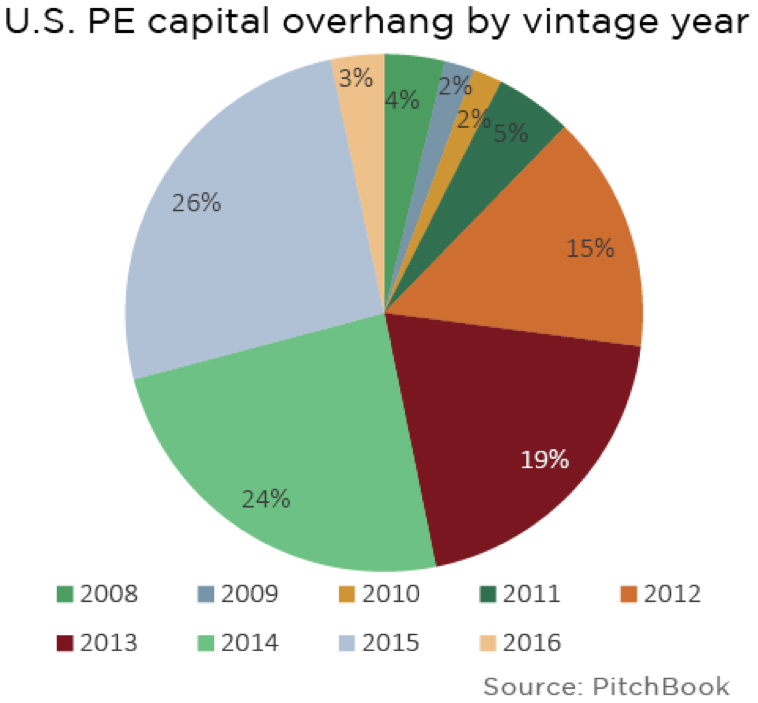 This one statistic underlines perhaps the most pressing issue facing general partners as 2016 gets underway: in the current dealmaking environment, where are they going to deploy their more-than-ample stores of dry powder? Investment timelines are running long—soon, some renegotiation or rolling forward of commitments into new vehicles will be necessary. It’s not so much the lack of targets, as the quality of companies in the market and current asking prices that seem to be giving investors pause currently, primarily the former. Even though the credit cycle is likely working through a prolonged seventh inning—or may well be in the early stages of the eighth—conditions remain amenable in the middle market in particular, enabling a fair amount of deal flow. But quality remains an issue, and coupling that with the uptick in caution, the investment timeline may be prolonged in many cases. In a mitigating factor, however, the sheer amount of aging dry powder that remains uncommitted represents a significant opportunity cost for both GPs and limited partners, compelling both to action. Accordingly, PE firms will seek to invest at a decent clip, likely producing a fairly substantial rate of deal flow, even if overall activity slumps compared to last year’s numbers.




Latest news

US leveraged loans returns turn negative in October
The Bloomberg US Leveraged Loan Index (Ticker: LOAN) has returned -0.26% this month through October 21, reducing its year-to-date return…

M&A activity begins to tick upward
In the third quarter of 2026, acquisition-linked loan volume across North America and Europe reached about $47 billion, up from $30.6 billion in Q2 and $29.5 billion a year ago.
