



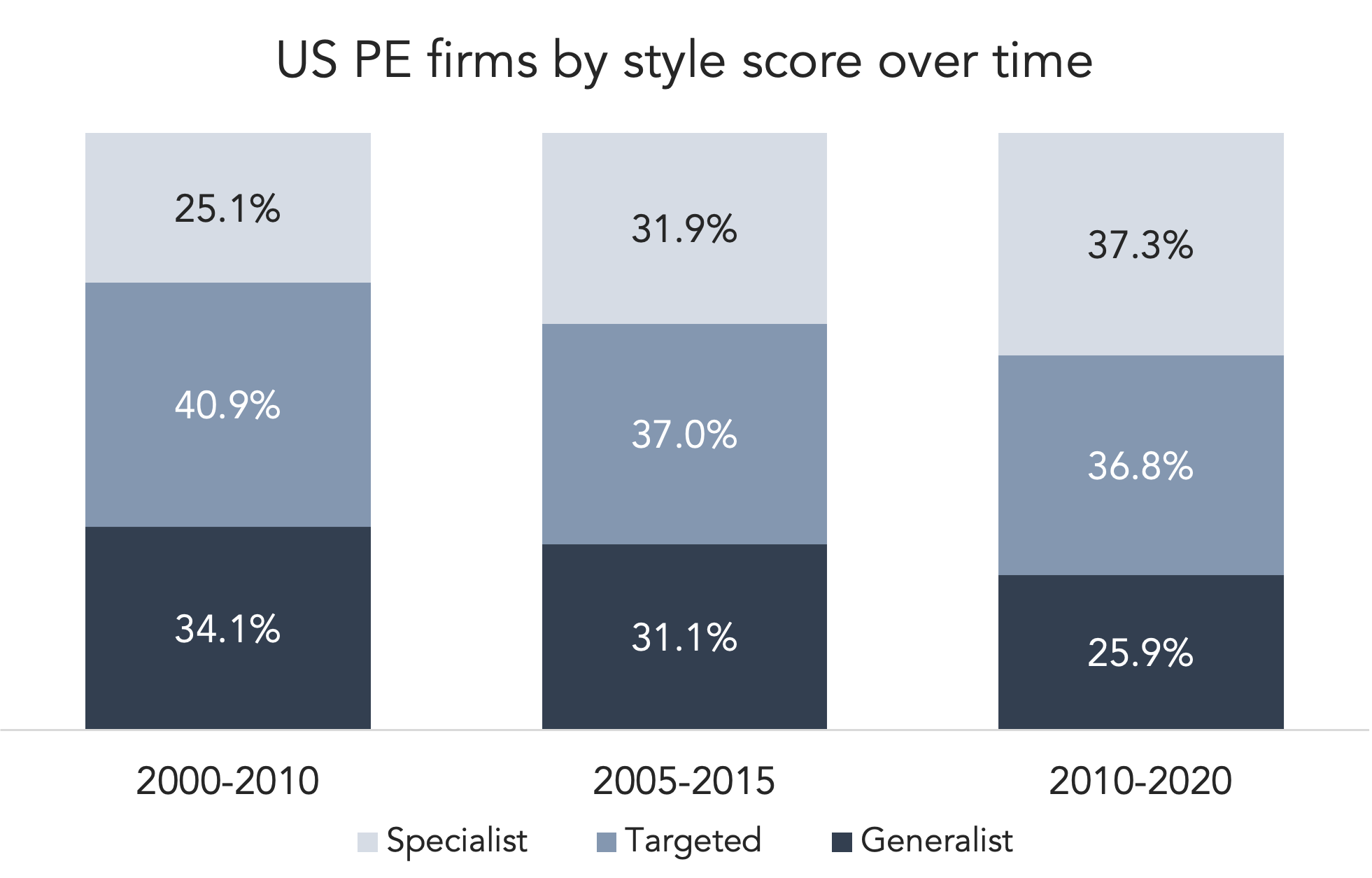
An upcoming PitchBook analyst note takes a look at GP style drift. It’s an important topic but a frustrating one for LPs. Quantifying the drift is tricky. Our framework assigns style scores to the PE firms themselves over time, instead of at the fund level. We broke the style definitions into three broad categories—generalists, specialists, and “targeted”, which is something of a middle-ground between the two extremes. The time element is staggered, with overlapping ten-year buckets that show the gradual drifts over time.
In the chart above, the obvious trend is a shift away from the generalist category and a growing representation for specialists. Between 2000 and 2010, generalists accounted for 34.1% of the PE universe compared to only 25.9% for the 2010-2020 vintage bucket. The opposite happened for specialists, which now account for 37.3% of all PE firms compared to 25.1% a decade earlier. The “targeted” category doesn’t shift very much in percentage terms, but that’s actually where most of the action happens. Generalists can become narrower over time while specialists can expand their focuses as they grow. Both would eventually wind up in the same middle category.
All of this is important for LPs, who are concerned about the trend. More specialization is a positive overall, but as LPs have become more sophisticated, so have their allocation models. A hypothetical LP might target a 10% allocation to consumer-focused funds and another 10% to software focused ones. GPs that decide to go in different directions, however slight, can cause a ripple effect across dozens of LP portfolios. There’s also the concern that they’ll be able to pull off the transition. Second basemen and third basemen are both infielders but require slightly different skillsets to do their jobs well. By definition, LPs have limited control over internal decision-making at the GP level; they can’t be team manager and require their players to stay in one spot. The hope is that the transition works out well and returns don’t suffer. They may need to find another second basemen to get their allocations intact again, too.
Contact: Alex Lykken
alex.lykken@pitchbook.com




Latest news


PE fund distribution rates
Following 2021, buyout distribution rates have fallen to roughly 10% to 15% below the 25-year average.

Sub line pricing flattens
A report on the topic also finds that investors are less concerned by leverage in NAV loans. Pricing for subscription…