



Download PitchBook’s Report here.
We mentioned last week that the flagship funds of public PE firms are now bigger than they were pre-crisis, while the same (mostly) can’t be said for private firms. The cynic might point out the obvious, that public firms are incentivized to raise more money because higher management fees help their stock prices. That’s true, but it’s still notable considering how many private firms have yet to reach their pre-crisis heights. Another cynical take on public firms is that they raise not just bigger funds but more funds for largely the same reason. One interesting tidbit from our recent analyst note, however, is that today’s now-public firms were actually diversifying decades before they IPO’d. The more-strategies strategy has been in their DNA for a while.
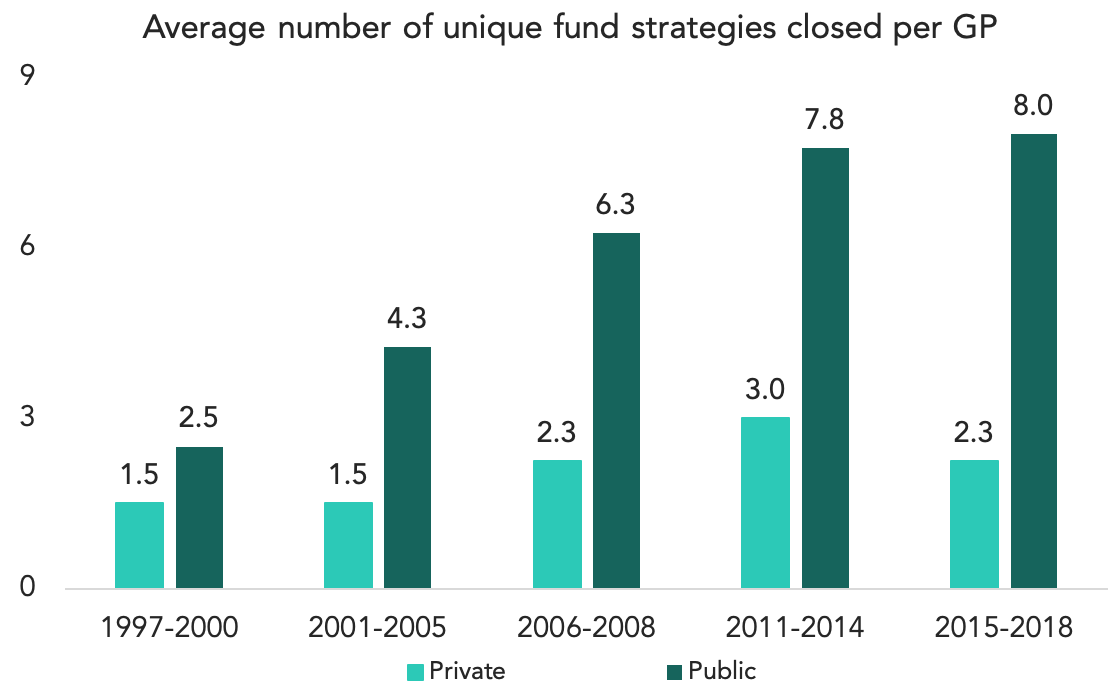
Starting in the late 90s, the firms that would eventually go public had, on average. 2.5 unique fund strategies to their name, compared to only 1.5 for the private cohort. By 2001-2005, when the PE market really got rolling, the firms that eventually went public had an average of 4.3 strategies, while the four private firms stayed put at 1.5. At the fever pitch of 2006-2008, the difference swelled 6.3 to 2.3, while today’s gap is even starker at 8.0 to 2.3. Firms like Blackstone and KKR are getting closer to becoming asset managers rather than mere buyout shops. None of which is to say that fund diversification is the gold standard, and other firms are somehow less worthwhile because they only do bread-and-butter buyouts. Just the opposite sometimes: Many LPs value focused strategies, as long as they can get into one of them.


Latest news

Share of PE middle-market deal count by backing type
Add-ons remain the workhorse for middle-market deployment, accounting for 67. 1% of all middle-market transactions YTD, in line with activity seen in recent years.

Software deal share falls in middle markets, rises in large caps
In Q3’26 software’s share of total deals fell in both the Lower Middle Market (to 7%) and Upper Middle Market (to 9%), while Large Cap saw a modest uptick in share to 8%.

Secondary loan prices stabilize following steep declines
Secondary loan prices came under significant pressure through September and October, with the Bloomberg U.S. Leveraged Loan Index declining 119…