



Download PitchBook’s Report here.
We tend to think of PE’s halcyon days as 2005-07, the dealmaking and fundraising bonanza years right before the music stopped. Industry players who have been around long enough probably remember better times and slightly better numbers. The industry is certainly much bigger and busier than it used to be, but not necessarily better, at least in terms of across-the-board outperformance.
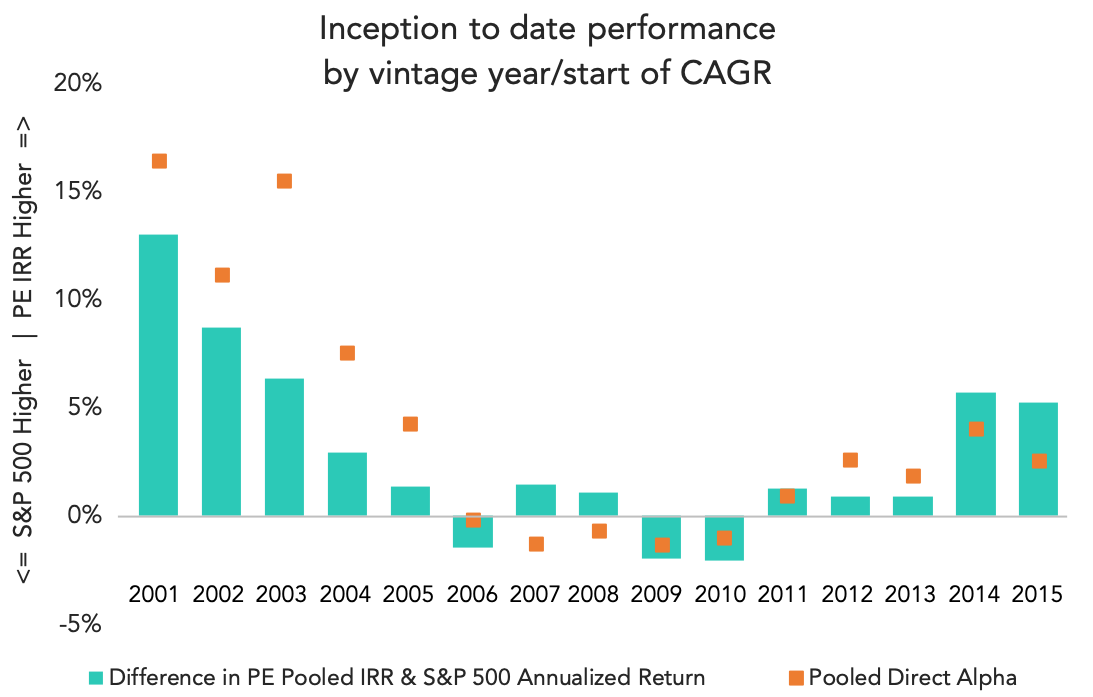
For the early 2000s vintages, PE funds in aggregate generated alpha values ranging between 7.5% and 16.4%, according to PitchBook’s just-released Benchmarks report. The graph above tries to capture Direct Alpha, which can be thought of as “an annualized KS-PME”—public market equivalent—that takes into account “both the performance of the reference benchmark and precise times at which capital is actually deployed.” The highlight-reel vintages of 2001-03 combined below-average public market performance (dot-com burst) and above-average PE gains, when the asset class was still relatively greenfield. PE’s hardest relative performance, not surprisingly, came during and around the financial crisis, when pooled direct alpha slipped into negative territory for the first time. Direct alpha recovered by 2011, but relative outperformance remained pretty stagnant over the next four vintages.
Alpha might be harder to find, despite marketing materials that say otherwise. Bull markets can be fairly blamed, but active managers are supposed to outrun the bulls. It might be a combination of more (more data, more investors, more dry powder) and less (less arbitrage, less companies, less options) that are the true pain points across PE and a slew of other asset classes. Private equity’s calling card, though, has been information and control over that information. Put another way, PE sponsors can make fundamental changes to their portfolio companies without letting the rest of the market know what those changes are every three months. That’s supposed to be a key advantage over the public market. Private equity can take a truly long-term approach to influence the direction of its investments in ways that other asset classes can’t.







Private Credit Defaults 101: Back to School
As Labor Day approaches, the unofficial end of summer is upon us. But, before we get too sad, there is also the familiar back-to-school energy.