



Secondary buyouts have been a contentious part of the PE industry for a long time. Limited partners are the most vocal about “pass-the-parcel” deals; in rare cases they are both buyer and seller of the same company (if they’re invested in both funds), but even when that’s not the case, studies suggest that less value is created after the company’s first LBO. One implication is that SBOs are avoidable and should be avoided when possible. That’s getting harder and harder to do these days, as PE’s success has attracted more capital, resulting in more companies coming under PE ownership and reducing the number of untouched targets in the market. LPs and other critics need to remember that private equity is no longer greenfield—PE firms would prefer the old days, too, but they aren’t coming back.
But there are upsides that partially balance out the downsides of SBOs, according to our latest analyst note to be published this Friday (it will be available here). Foremost is risk reduction – companies that have already been through PE ownership are less likely to go bankrupt under new PE ownership. While the private equity model has earned its advocates thanks to market-beating returns, the prospect of failed investments is always there. To some degree, less reward means less risk in this case. Somewhat surprisingly, we found another upside we weren’t expecting—shorter hold times compared to primary buyouts (PBOs). The assumption was that subsequent owners would need more time to generate value, since most of the low-hanging gains would have been realized already. At least since 2014, however, SBO holding periods have been shorter than PBO holding times, and hold times were even shorter for “echo buyouts” (three or more rounds of ownership). One potential reason is the added scrutiny GPs face when considering an SBO. Solidified value-creation and exit plans carry additional importance for SBOs, not only for LPs financing them but for the GPs themselves. Buy-side SBOs present an opportunity risk for GPs, who always run the risk of overlooking other opportunities in favor of what’s in front of them. Time is money, and the faster turnover of SBOs has a positive impact on their returns and, ultimately, the fund’s IRR.
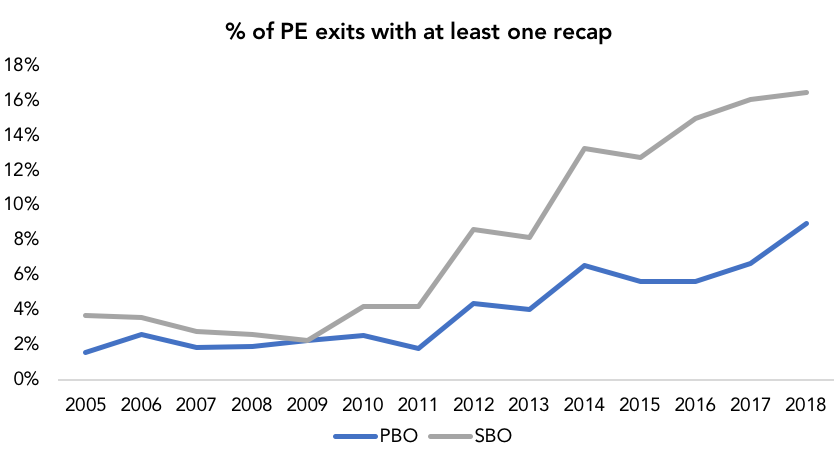
One final upside: We found that SBOs are more likely than PBOs to undergo some sort of recapitalization during their holding periods. That’s a significant (and not surprising) value generator when those recaps take the form of dividends. More dividends (i.e. more debt obligations) offer another avenue to criticize SBOs, but LPs aren’t as likely to lead the charge on that front.
Contact: Alex Lykken
alex.lykken@pitchbook.com
Latest news

Share of PE middle-market deal count by backing type
Add-ons remain the workhorse for middle-market deployment, accounting for 67. 1% of all middle-market transactions YTD, in line with activity seen in recent years.

Software deal share falls in middle markets, rises in large caps
In Q3’26 software’s share of total deals fell in both the Lower Middle Market (to 7%) and Upper Middle Market (to 9%), while Large Cap saw a modest uptick in share to 8%.

Secondary loan prices stabilize following steep declines
Secondary loan prices came under significant pressure through September and October, with the Bloomberg U.S. Leveraged Loan Index declining 119…