



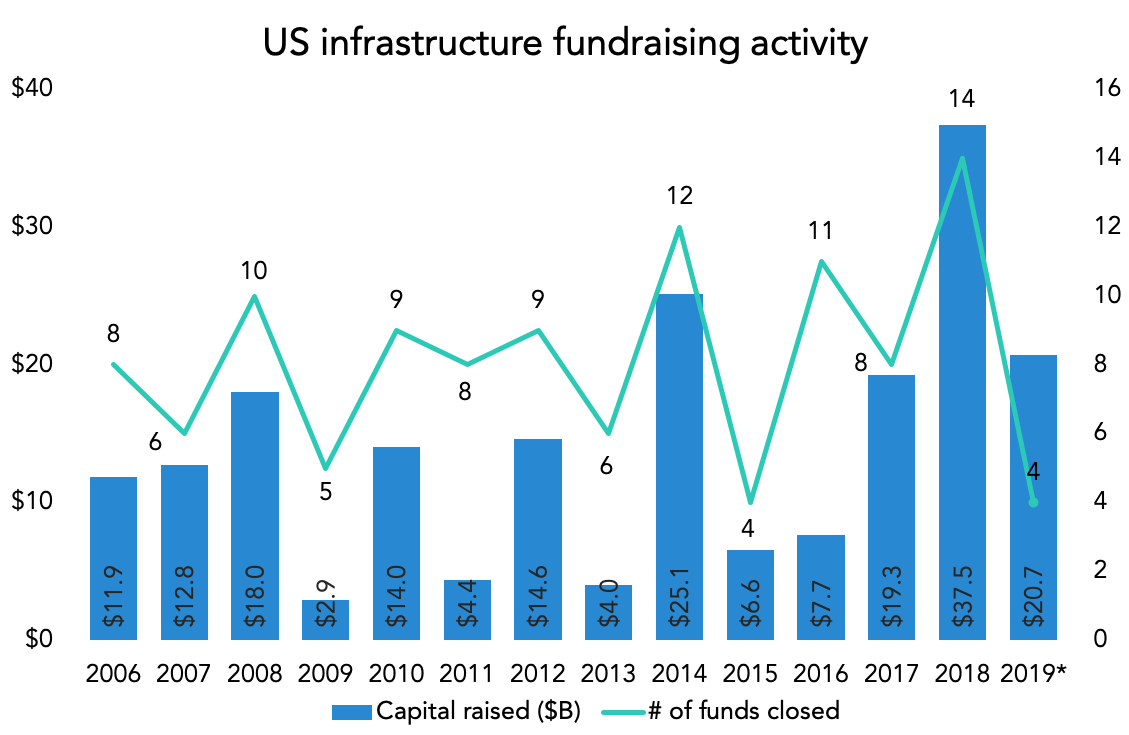
Almost three political centuries ago, expectations were high for a bi-partisan and highly funded infrastructure bill. While a lot has happened since January 2017, the promised infrastructure package was not one of them. Recall, though, the fervent efforts among PE investors to piggyback off of those plans. Blackstone made the most headlines with a push to raise $40 billion in a single infrastructure fund, announced in May 2017. All told, a little over $77 billion has been raised across the industry for US infrastructure spending since January 2017, half of which closed last year. A large sum to be sure, but still puny compared to the $500 billion bill promised during the 2016 campaign.
Investors have plenty of deals and projects to target: The American Society of Civil Engineers gave the country a D+ in its 2017 report card, estimating the cost of necessary improvements at $4.6 trillion. If and when an infrastructure bill passes congress, investors will be at the ready, and we’d expect to see more funds enter the picture on top of the current crop. There is a cautionary tale here, though, about the potential perils of chasing sure-thing political plans. PEGs played their cards right the last time this happened, with Obamacare. The market was expecting a big surge in healthcare investment, particularly around electronic health record systems. The new legislation (at the time) effectively mandated electronic recordkeeping across wide swaths of the industry. Predictably, investors flooded into that market and consolidated like crazy, and many made a lot of money. But there was also more caution at the time because the healthcare bill itself was never a sure thing. It barely squeezed by, but contrary to the 2016 infrastructure promises, it at least was put to a vote. Presumably, the $77 billion worth of infrastructure funds floating around have plenty of solid backup plans.


Latest news

Share of PE middle-market deal count by backing type
Add-ons remain the workhorse for middle-market deployment, accounting for 67. 1% of all middle-market transactions YTD, in line with activity seen in recent years.

Software deal share falls in middle markets, rises in large caps
In Q3’26 software’s share of total deals fell in both the Lower Middle Market (to 7%) and Upper Middle Market (to 9%), while Large Cap saw a modest uptick in share to 8%.

Secondary loan prices stabilize following steep declines
Secondary loan prices came under significant pressure through September and October, with the Bloomberg U.S. Leveraged Loan Index declining 119…