



Every big theatrical release eventually makes its way to streaming. It gives people who missed it in theaters a chance to catch up, and lets those who saw it go back for a second look at what they missed the first time. The Lead Presents: Making Sense of Private Credit Defaults had its own debut the other week, drawing more than 700 registrants for a conversation with all four major rating agencies on how they calculate and measure defaults. With the replay now live, we wanted to walk through a recap of our conversation. Here are the key scenes worth revisiting.
The session picked up right where Different Numbers, Different Stories left off. The reason default rates range so widely is that everyone’s measuring something slightly different. One firm may focus on missed payments. Another might include distressed exchanges like maturity extensions and PIK amendments. Even the composition of the universe can differ, whether it’s the size of the sample, how it’s weighted (by issuer or by volume), or whether it includes loans further down the capital stack rather than those most senior. As one panelist framed it, these differences don’t mean one rate is more right than another. They each serve a purpose, because it’s a non-homogeneous market.
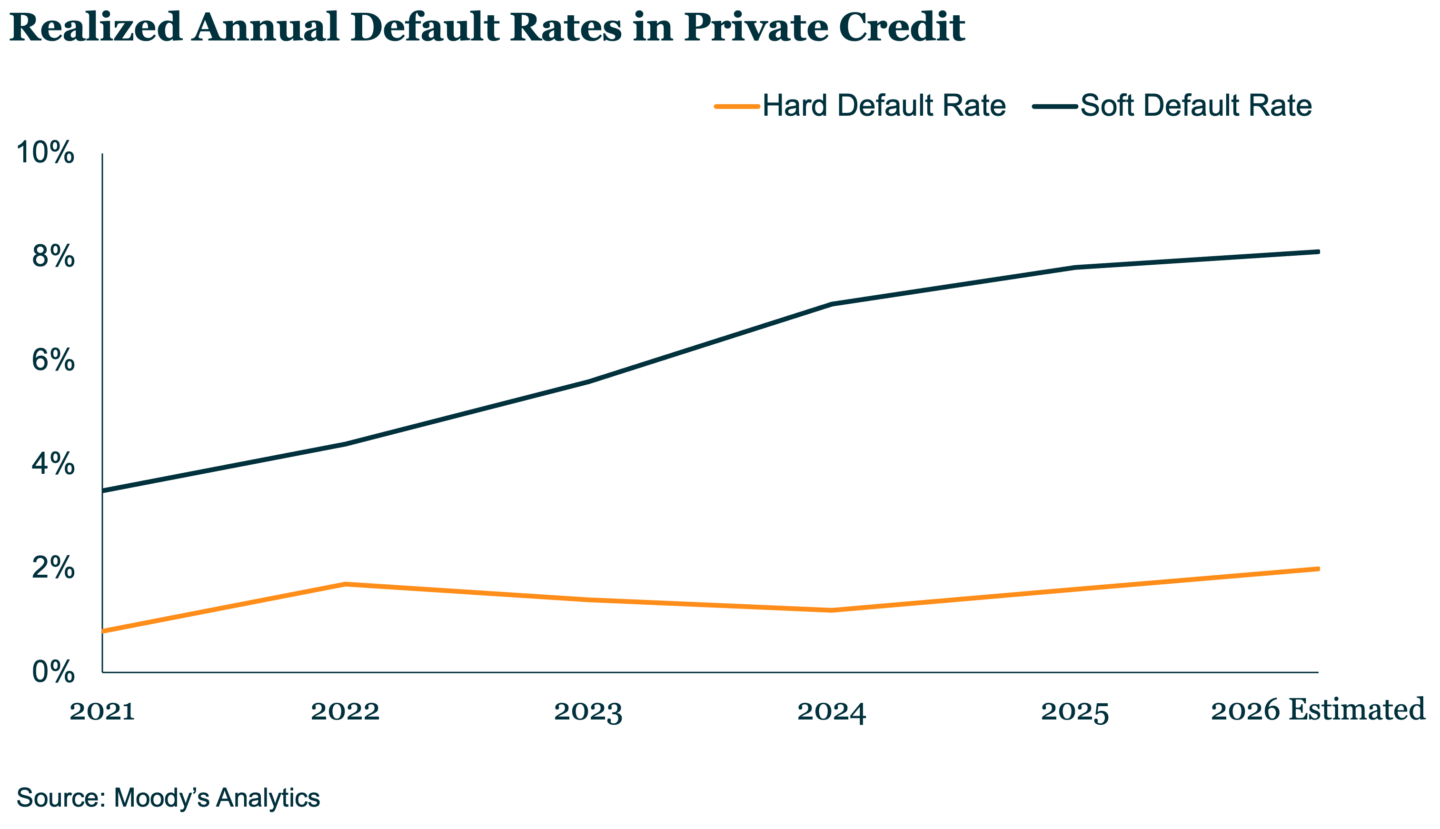
The bigger theme, though, was the growing gap between “hard” and “soft” defaults. Soft credit events, which includes maturity extensions, PIK amendments, and covenant breaches, are what make up the so-called “shadow rate.” According to Moody’s, these soft credit events have risen from roughly 3.5% to nearly 8% since 2021 (see Chart). Hard defaults, meanwhile, missed payments and bankruptcies, have stayed in a range of 1-2% over that same stretch. That’s consistent with a point we’ve made throughout this series, that middle market direct lenders have a number of tools to get back to the table early, before those problems turn into a real loss.
Software, everyone’s favorite topic this year, came up too. The takeaway is that AI’s impact on the sector is more nuanced than an “AI is coming for credit” headline would suggest. Fundamentals still look strong by most measures, with healthy growth rates and low defaults. But a few panelists flagged that risk looks concentrated in specific business models, with application-layer software facing more pressure than the sector overall. With a meaningful maturity wall still ahead, panelists noted they’re watching closely to see how that plays out.
Finally, we walked through recoveries. Like software, the story is nuanced. Recovery rates have moved lower and are converging to levels in the broadly syndicated and high yield markets. But similar to what we covered in Scrambling for Par, tighter middle market documentation is still providing a real cushion, particularly for smaller companies. S&P found recoveries on smaller middle market loans running near 84 cents on the dollar, well above the 68 cents typical for larger deals.
Consider the credits rolled. But like any rewatch, it’s easier to connect the smaller details. Since the beginning of September, we’ve been trying to convey two things: a default rate depends on how it’s measured, and what you actually lose depends on the recovery that follows.
For those who missed it live, the replay is below. Trust us, it’s worth your time.


Latest news
Behind the Scenes
Climbing toward the average is a very different story than surpassing it.

European mid-market direct lending margins face steady compression since 2024
European mid-market direct lending margins have seen consistent compression over recent years but recorded a slight increase in the second quarter of 2026…

US leveraged loan issuance rebounds in September
Following three consecutive months of declining issuance, the US leveraged loan market has reversed course in September. Approximately $48.7b of…