


Highly levered middle market issuers could struggle if rates continue to rise

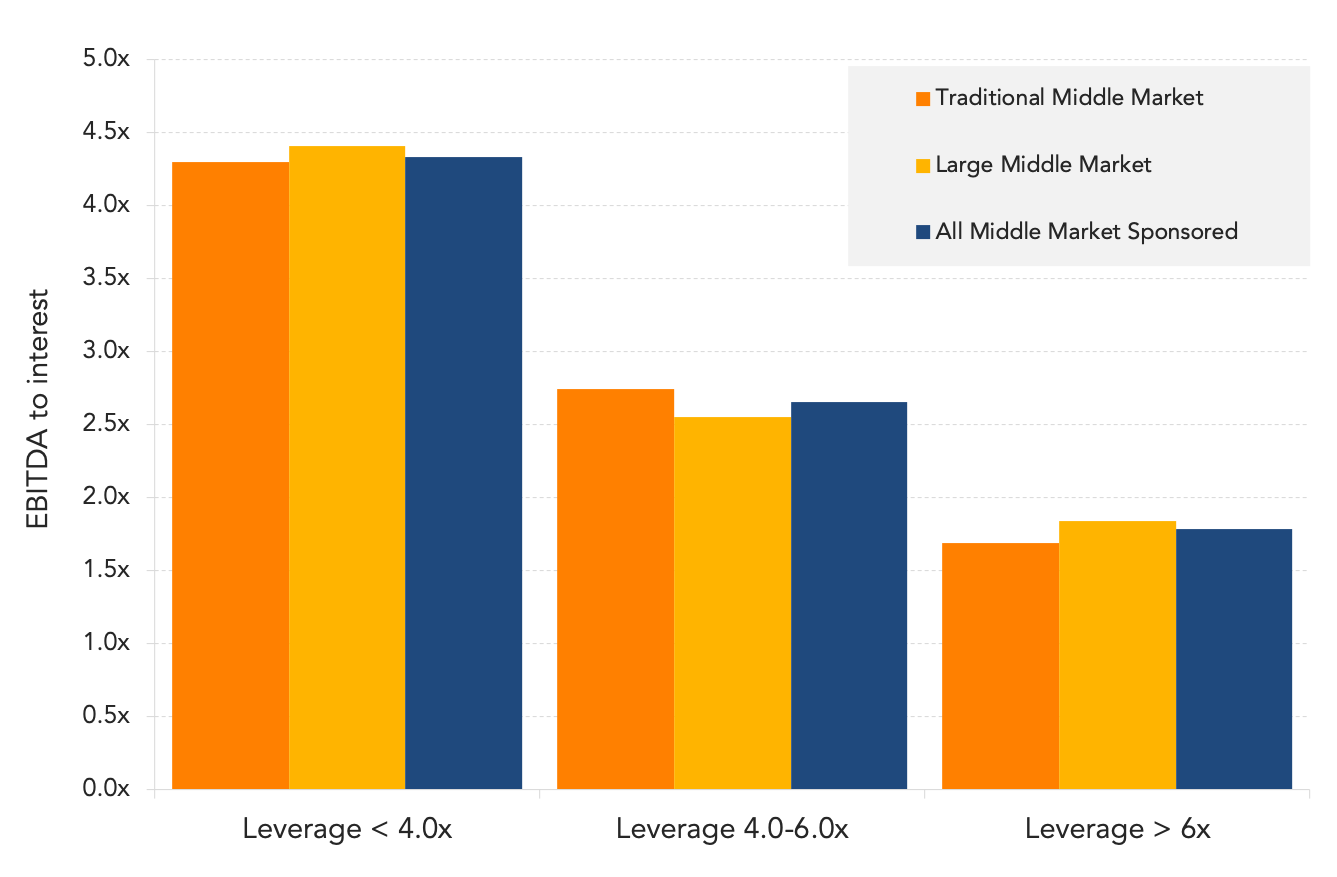
Throughout most of this credit cycle, the Libor benchmark rate has remained extremely low making it quite easy for issuers to meet interest payments. However over the past year, three-month libor has risen over 100bps to 2.75%. While the Fed has recently tempered their expectatations for future rate rises, lenders are still turning their attention more now to the EBITDA to interest metric to make sure issuers are fully capable of making interest payments. In the middle market, for sponsored deals levered under 4.0 times, EBITDA to interest was extremely strong in 4Q18 at 4.3 times. However, as leverage increases, the strain on EBITDA to interest coverage ratio increases. For deals levered between 4.0 times and 6.0 times (the bulk of middle market deals reside here), the interest coverage ratio fell to around 2.65 times in 4Q18. And for deals levered north of six times, the average interest coverage ratio dropped to 1.78 times, leaving little breathing room for issuers to navigate a potential economic slowdown. In this cycle, many middle market issuers were acquired by sponsors for the first time and are not used to operating their businesses with lofty leverage levels and reduced interest coverage ratios. Couple this with additional rate rises, wider spreads given volatiility, decreasing operating margins driven by slowing global growth, increased raw material and transportation related costs and rising wage pressure and it could be challenging for some smaller middle market issuers to navigate with a heavy interest burden.
Contact: Fran Beyers
frances.beyers@thomsonreuters.com






Private Credit Defaults 101: Back to School
As Labor Day approaches, the unofficial end of summer is upon us. But, before we get too sad, there is also the familiar back-to-school energy.