


Markit Recap – 12/11/2017

Italy CDS – watch the ISDA basis
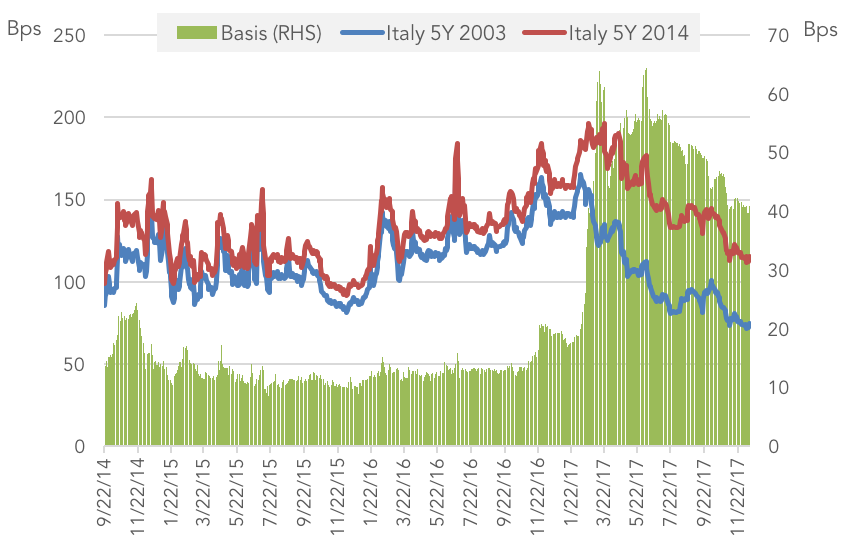
This year was widely touted by many – including yours truly – as the year of political risk. As we now know it didn’t turn out that way. Emmanuel Macron fought off the challenge of the National Front, Mark Rutte was re-elected as Dutch Prime Minister and Italy didn’t hold yet another general election. CDS spreads duly recovered and look set to end 2017 close to multi-year tights.
But Italy may yet act as a catalyst for volatility in 2018. Reports that elections are to be held on March 4 led to Italy’s sovereign CDS widening from 112bps to 115bps. It wasn’t a massive move – Italy’s legislative five-year term was due to end next year, making an election inevitable – but it served as a reminder that political risk hasn’t been, and can never be, eliminated.
An electoral law passed last year means that a party, or bloc of parties, has to achieve 40% of the vote to form a government. The latest polls indicate that all of candidates will fall short of the 40% threshold, with a political impasse the probable result.
Investors are used to such a scenario in Italy, so while the uncertainty would be unwelcome, it is unlikely to trigger contagion across Europe. If a right-leaning populist government were somehow formed, however, then that would pose an altogether different pricing challenge. The Five Star Movement is riding high in the polls but has ruled out joining forces with the other parties, so will need a strong surge to have any chance of winning. Silvio Berlusconi and the Northern League have formed a right-wing alliance and will also pose problems for the centrist parties.
Credit investors will clearly be focusing on Italy’s enormous debt burden – currently around 135% of GDP – and the future government’s plans to tackle it. But perhaps more pertinent in the near-term will be the proposed direction on Italy’s status in the eurozone. The populist parties have all made noises about exiting the euro, and polls suggest ant-euro sentiment in Italy is the highest in Europe (even higher than Greece). But concrete policies are thin on the ground, and the CDS markets will be watching closely for further news during the campaign.
Changes in CDS sentiment on this issue will manifest itself through the ISDA basis (the difference between spreads on 2003 and 2014 definitions). The 2014 definitions explicitly allow for redenomination after leaving the Eurozone, hence will trade wider than their 2003 counterparts. We saw the basis increase when the anti-euro National Front was leading the polls in France earlier this year. It has since declined but remains at historically wide levels. This measure will be an important indicator of political risk in the run-up to the election.
Contact: Gavan Nolan
Gavan.Nolan@ihsmarkit.com





Latest news

Rate hike expectations ease as term SOFR curve flattens
The CME six-month Term SOFR rate reached a recent high of 3.979% on July 28 before retreating to 3.837% as…
3Q26: New loan assets rise to 44% of total lending, a 3-year high
New loan assets as a proportion of total US loan volume make up 44% of the 3Q26 pipeline to date,…

North American GPs dominant as fundraising accelerates
Our PEI Private Credit 200 ranking also shows capital raising increasing overall – and accelerating especially fast for the largest…