Markit Recap – 3/6/2017

We noted last month that credit markets are still sensitive to political polls, despite doubts about their accuracy.
In particular, sovereign cds in Western Europe was responding to polls showing National Front leader Marine Le Pen surging ahead in the race to become France’s next president. Le Pen has stated that she is in favour of leaving the EU under the current framework, so it was no surprise to see France’s spreads widen when she took the lead in the polls.
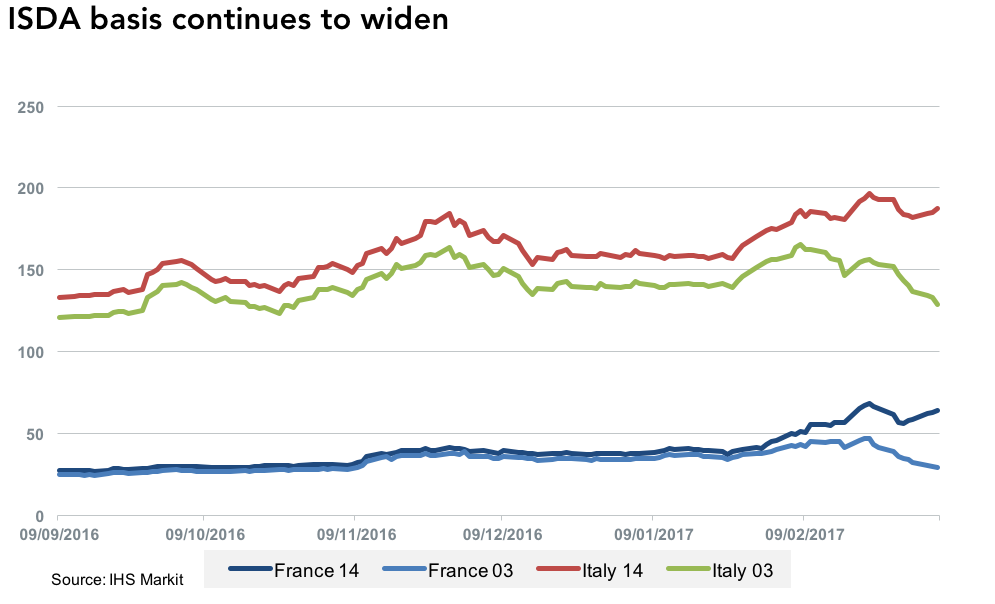
But it was the behavior in the “ISDA basis” – the difference between sovereign CDS trading under 2014 and 2003 definitions – that caught our attention. Before Le Pen’s surge in popularity, the basis was stable at around 3bps. After her gains in the polls, the basis increased to 23bps in the final week of January.
The cause of the basis increase? We highlighted the recognition of euro debt redenomination under the 2014 definitions, as well as the asset package delivery provision, as likely drivers. The 2014 contact has more value in a scenario where a country could leave the euro, though it is far from certain how this would play out if a Eurozone country’s debt was redenominated in another currency.
So one would expect the basis to shrink if the threat of a Le Pen victory and subsequent referendum on EU membership diminished? Centrist, pro-EU candidate Emmanuel Macron has gained ground in recent weeks, and took the lead for the first time in polls for the initial round of voting. He is expected to be an emphatic winner if there is no outright majority and there is a run-off vote, as is usually the case.
But the shrinkage in basis hasn’t happened. In fact, the opposite has occurred – the basis has widened to 35bps. The 2003 contract has performed as expected, tightening to 28bps. But the 2014 spread has widened from 58bps to 64bps, close to the 68bps it reached in late February. This is an unusual phenomenon – the 2014 and 2003 contracts move together the vast majority of the time. And it is not just in France CDS. The basis in Italy has risen from 45bps to 59bps in the space of a few days.
Technical factors can often cause dislocations in the market. Liquidity varies between the two contracts, particularly in higher quality credits. Italy, however, is liquid in both 2003 and 2014, which suggests other reasons. Perhaps there is a fundamental driver of the basis. Even if the polls are moving away from Le Pen, markets are well aware that polls are unreliable. The 2014 sovereign CDS contract, denominated in US dollars, is tailor made as a hedge against the mother of all tail risks – a core EU country leaving the eurozone.
Contact: Gavan Nolan
Gavan.Nolan@ihsmarkit.com



Latest news

With inflation running hot, rate hike expectations strengthen
A hotter-than-expected inflation reading has renewed expectations for near-term Federal Reserve tightening. The Consumer Price Index rose 0.6% month-over-month, pushing…

Open Tab
Leveraged loans keep running up a tab. Senior direct lending already knows what it owes.