Markit Recap – 9/5/2016

https://theleadpc.com/wp-content/uploads/2026/06/cropped-THE-LEAD-ICON.png
Content hub / Article / Markit Recap – 9/5/2016

Emerging market economic growth managed to hang on to much of its momentum over August according to the latest release of the IHS Markit Emerging Market Composite PMI index. The August reading indicated that emerging market economies stayed in expansion territory for the third month in a row for the first time since the spring of last year. Growth in developed economies, while still in expansion territory, continued to be challenged with the current pace of expansion materially lower than the pace seen at the turn of the year.

TLL080916

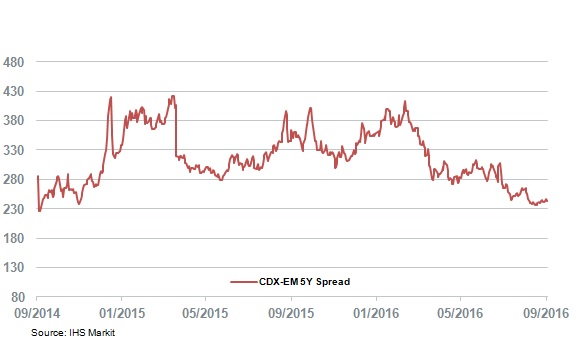
The diverging growth momentum between the two sets of economies has helped assuage investor sentiment towards emerging market credit risk, evidenced by the Markit CDX EM index, which tracks a basket of emerging market CDS contracts falling to its lowest level in over 18 months.

This improving sentiment has been universal given that every single one of the index’s 14 constituents now trades with a tighter CDS spread. Even countries experiencing political turmoil such as Brazil and Turkey are trading materially lower for the year so far.

This relentless risk rally has translated into real returns for the holders of dollar denominated emerging market bond holders as the asset class which has proved to be one of the winning fixed income trades of the year so far. The asset class’ outperformance was extended last month when Markit iBoxx USD Emerging Market Sovereign index delivered 1.7% of positive total returns. This feat, which was 230bps more than the total returns delivered by treasuries over the month, takes the year to date total returns delivered by emerging market sovereign bonds past the 13% mark, over twice that delivered by US treasury bonds.

Strong returns delivered by sovereign EM bonds has knocked over 110bps off the asset class’ yield ytd, which is nearly twice the tightening seen by US Treasuries bonds over the same period of time. These plunging yields mean that US investors are now receiving 2.9% of extra yield by parking their money in dollar denominated EM sovereigns, which is roughly 20bps less than the average extra yield delivered by the trade in the six years since the Markit iBoxx USD Emerging Markets Sovereigns launched in 2010. This has left some wondering how long the good times can last.

Investors have shown little signs of being turned off as the shrinking extra yield offered by dollar denominated EM bonds at the moment as ETFs which invest in the asset class have continued to experience strong inflows over the last few weeks. These consistent inflows have extended the asset class’s inflow streak to 18 weeks, which extended the record year to date inflow tally gathered by EM government bond ETFs. The $12.24bn which has poured into the asset class ytd is over $5bn more than the previous record set back in 2012 which underscores how popular the trade has been with today’s yield and growth hungry investors.
Contact: Simon Colvin
simon.colvin@ihsmarkit.com
Business development companies and the rise of balance sheet financing vehicles

Podcast

Business development companies and the rise of balance sheet financing vehicles

Fitch's Deb Murnin and Chelsea Richardson discuss the growing use of off-balance-sheet JVs and finance companies among BDCs, exploring the drivers, leverage impacts, portfolio risk profiles, and potential rating implications for Fitch-rated BDCs.
Listen
Private Debt Investor New York Forum

September 15-16, Hudson Yards, New York

Private Debt Investor New York Forum

Bringing together the investors, managers and advisers shaping the next phase of the market — 200+ allocators and $10.6 trillion of LP capital expected. Benchmark strategies, hear from leading LPs, and cut through market noise over two unmissable days.
Learn more
US Private Credit League Tables H1'26

Report

US Private Credit League Tables H1'26

The definitive rankings covering private credit activity in H1'26.
Download
PitchBook's Q2 2026 US PE Breakdown

Report

PitchBook's Q2 2026 US PE Breakdown

Software freezes and energy powers on as US PE deal value falls 38% in Q2 2026.
Download
Making sense of private credit defaults

Webinar

Making sense of private credit defaults

What does private credit default data really tell us? Join our exclusive webinar featuring experts from KBRA, Moody's, Fitch Ratings, and S&P Global to find out.
Register

Latest news

    Rate Hike Expectations Regain Steam following Jackson Hole

    The CME six-month Term SOFR rate reached a recent high of 3.979% on July 28 before retreating to 3.821% as…

    Read More

    Private Credit Defaults 101: Back to School

    As Labor Day approaches, the unofficial end of summer is upon us. But, before we get too sad, there is also the familiar back-to-school energy.

    Read More

    Grading on a Curve

    Grades depend on how the questions get answered.

    Read More