



Our newly published investor survey reveals some concerns but a lot of support for private credit.
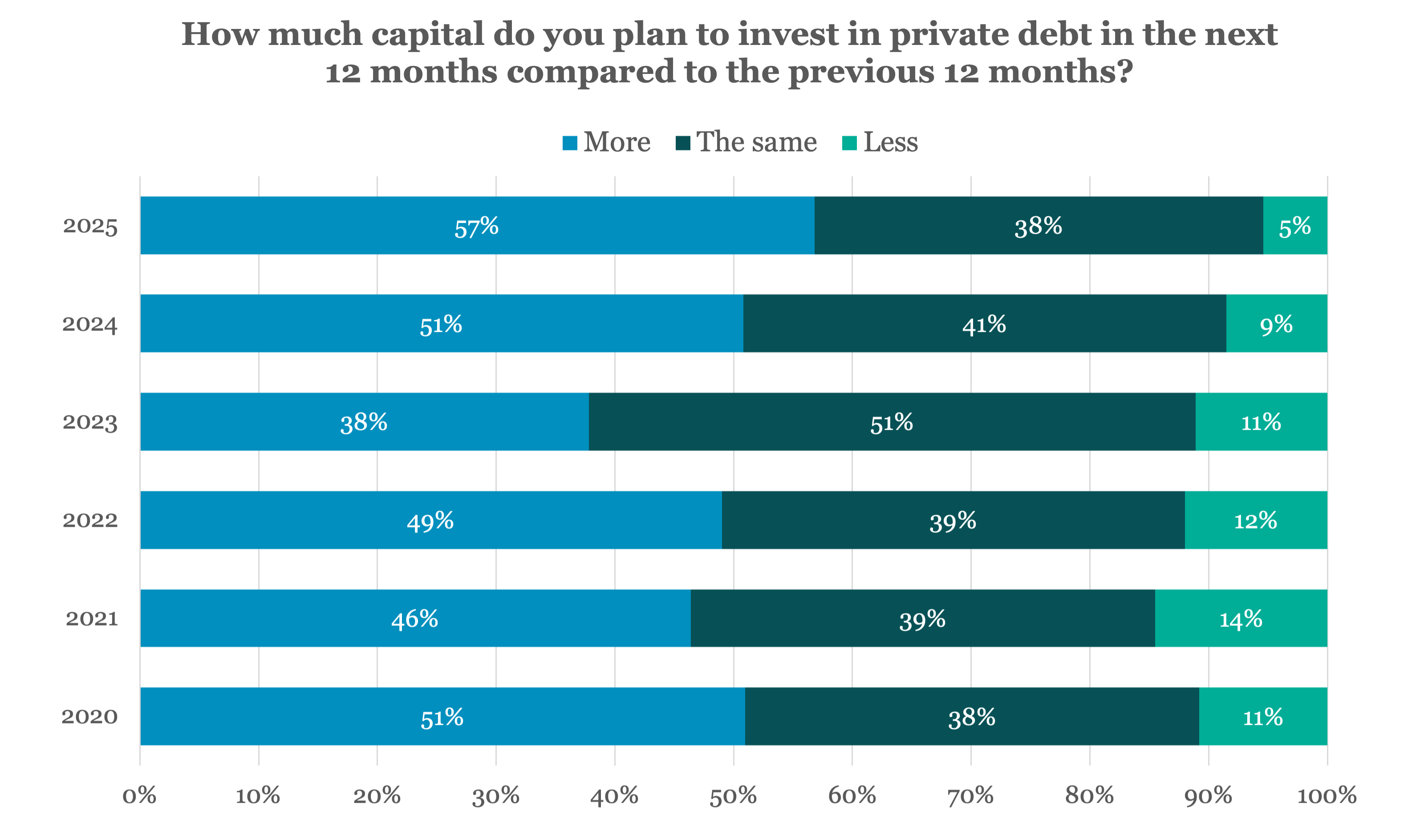
Investor confidence in private debt is strong in the early months of 2025. Our LP Perspectives survey – published in full last week – reveals that more than half (57 percent) of LPs want to increase their allocations to the asset class over the next 12 months.
As a young asset class, what private debt has in abundance is potential. Not a single respondent to the survey said they were over-allocated. Nearly half – 46 percent – considered themselves under-allocated and 54 percent were at their target level of exposure. Assuming private debt doesn’t experience some kind of major setback, it can’t really fail to be the recipient of large amounts of capital going forward.
Potential hazards do exist and shouldn’t be ignored. So far, the default rate hasn’t caused too many sleepless nights, but hidden default risk does appear to be causing anxiety.
The extent of the problem this could create for the asset class is expected to depend on the performance of the economy. A slow growth but relatively benign economy could bring somewhat reduced levels of liquidity and see returns edge down a little. That is a scenario people can live with. A sudden economic shock could topple many companies currently showing only minor signs of stress – that could be damaging for investors and for the asset class’s reputation.
Other investors point to the weight of capital available for investment – despite a slower fundraising environment, private debt has a large amount of dry powder – in a slower dealmaking market, and wonder whether too much competition for deals may be detrimental. Pricing and deteriorating credit quality on new loans are “yellow lights blinking on the dashboard”, according to one investor.
While investor sentiment towards private debt has remained positive in recent years, private markets in general have suffered on the fundraising front as LPs have found themselves restricted in their ability to make new commitments by the denominator effect and a lack of distributions coming back to them from the managers they have invested with.
However, while private debt has also seen a difficult fundraising environment, 78 percent told our survey that they were “not very” or “not at all” limited when it comes to making new commitments.





Latest news

Rate hike expectations ease as term SOFR curve flattens
The CME six-month Term SOFR rate reached a recent high of 3.979% on July 28 before retreating to 3.837% as…
3Q26: New loan assets rise to 44% of total lending, a 3-year high
New loan assets as a proportion of total US loan volume make up 44% of the 3Q26 pipeline to date,…

North American GPs dominant as fundraising accelerates
Our PEI Private Credit 200 ranking also shows capital raising increasing overall – and accelerating especially fast for the largest…