



Distressed debt has adapted to more benign market conditions but may revert to a ‘pure’ form as pressure on borrowers grows.
Distressed debt isn’t what it used to be. In the wake of the global financial crisis, there was a once-in-a-lifetime chance to invest in rebuilding a global economy that was in tatters. That was a genuine “pure distress” opportunity which made fortunes for some but may have burnt others.
Since then, market conditions have been occasionally volatile but never coming close to a repeat of what happened in 2008/09. In the wake of the covid pandemic, some fund managers raised dislocation funds – some of these vehicles were closed in a matter of weeks – to take advantage of what ultimately proved to be a short-lived crisis.
Overall, economic conditions over the last couple of decades have been broadly benign. But even with a tranquil economic backdrop, there will always be companies in need of complex financing that they may not be able to obtain from ‘plain vanilla’ providers. And this is why a host of labels have become increasingly familiar over the years: special situations, opportunistic credit, capital solutions…the list goes on.
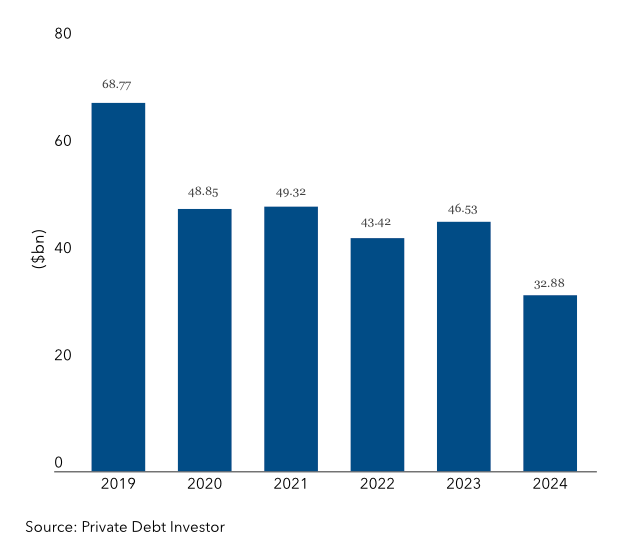
As can be seen from the chart above, distressed debt fundraising sunk to a new low last year. But it’s possible that 2025 may see something of a revival as investors take note of a changed economic and geopolitical backdrop in which stubbornly high interest rates and a likely revival of inflationary pressures will keep borrowers under pressure.
Certainly, distressed/opportunistic fundraising got off to a flying start with Oaktree Capital Management closing a $16 billion vehicle in February. It’s a part of the private credit market that may just be in line for something of a revival.





Latest news

Rate hike expectations ease as term SOFR curve flattens
The CME six-month Term SOFR rate reached a recent high of 3.979% on July 28 before retreating to 3.837% as…
3Q26: New loan assets rise to 44% of total lending, a 3-year high
New loan assets as a proportion of total US loan volume make up 44% of the 3Q26 pipeline to date,…

North American GPs dominant as fundraising accelerates
Our PEI Private Credit 200 ranking also shows capital raising increasing overall – and accelerating especially fast for the largest…