



As fund managers become adept at heading off problems before they threaten to kill companies off, distressed strategies are changing in nature.
The news in August last year that Oaktree Capital Management was in the market with an ambitious $18 billion target for its latest opportunistic credit fund highlights the burgeoning appetite among LPs for strategies predicated on supporting complex borrowers through challenging times.
If it hits its target, Oaktree’s Opportunistic Fund XII would be the largest private debt fund ever raised, signalling a major shift in investor appetite away from pure distressed strategies pursuing loan-to-own or workout situations.
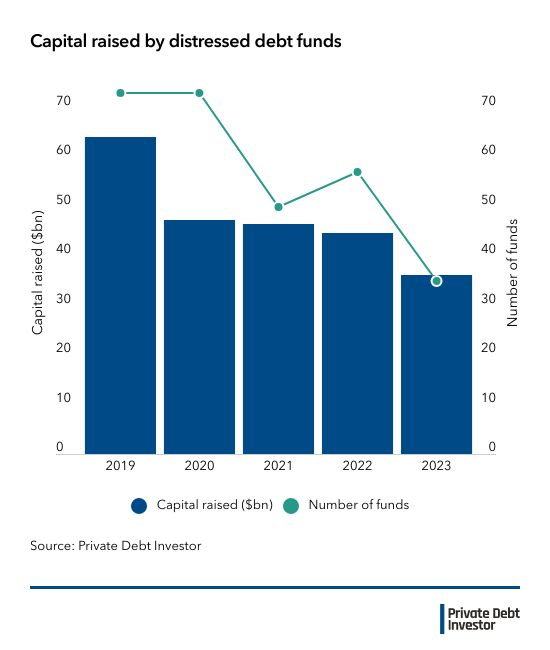
Last year saw $36.24 billion raised for opportunistic and special situations strategies, according to Private Debt Investor data (see chart), with the biggest fund closes including LCM Partners’ LCM Credit Opportunities 4 on $4.4 billion, and Oak Hill Advisors’ OHA Strategic Credit Fund III on $3 billion.
Over the past three years, by contrast, fundraising for distressed strategies has been flat at about $45 billion a year, dropping from a high of $81.5 billion in 2017 and down nearly 20 percent between 2022 and 2023. Last year saw just 35 fund closings, the lowest number in more than a decade, even as average fund sized climbed to a high of $1.7 billion.
At the recent PDI APAC Forum in Singapore, one panellist speculated that “pure distress” is now more or less obsolete as an asset class in its own right. So adept have fund managers become at nipping investee company problems in the bud that very few are ending up in the kind of court processes that fuel distressed deal flow.
As a result, strategies that ‘solve issues’ – opportunistic credit, special situations, capital solutions etc. – are capturing growing amounts of investor dollars. Pure distress, on the other hand, is struggling to make a case for support. Distress just ain’t what it used to be.





Latest news

Rate hike expectations ease as term SOFR curve flattens
The CME six-month Term SOFR rate reached a recent high of 3.979% on July 28 before retreating to 3.837% as…

3Q26: New loan assets rise to 44% of total lending, a 3-year high
New loan assets as a proportion of total US loan volume make up 44% of the 3Q26 pipeline to date,…

North American GPs dominant as fundraising accelerates
Our PEI Private Credit 200 ranking also shows capital raising increasing overall – and accelerating especially fast for the largest…