



The numbers are holding up reasonably well, but getting LPs to part with capital is becoming a tougher task in many cases.
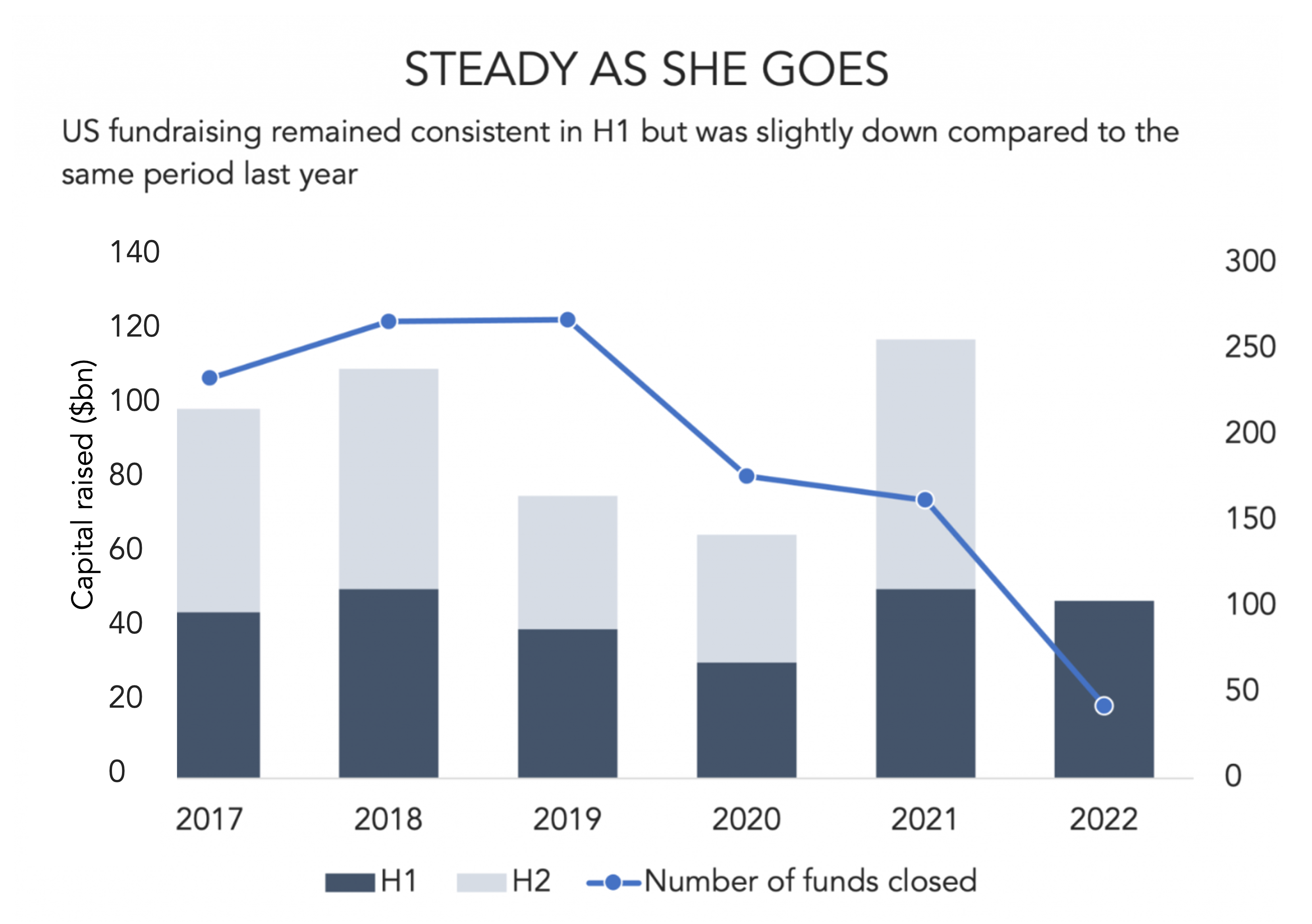
The sense of a market feeling its way through a new set of economic realities is apparent in Private Debt Investor’s fundraising figures for the first half of the year (see chart).
Just 41 North American private debt funds closed in the first half of 2022. Despite this, the amount of capital raised by the asset class in the first six months of the year was still up on 2019 levels. The average private debt fund size stood at $1.1 billion, far above the $730 million recorded in 2021, and half of all funds that closed exceeded their fundraising target.
While the number of funds closed in the first half is equivalent to a quarter of the number closed in 2021, PDI data shows investors are still willing to back sizeable credit funds, with a total of $48.2 billion raised, versus $51.4 billion in 2021.
Advisers say many LPs have pressed pause on their allocations and processes are taking longer, but the private credit asset class remains attractive to US investors.
Lorna Bowen, partner and chair of the US investment management group at Debevoise & Plimpton in New York, says: “It’s fair to say we are involved in quite a few fundraisings right now that are just limping along.
“Over the last 12 months, a lot of the products we have launched with clients have got to the finish line, but it has been a grind. But then there are plenty of others that have been very quick to launch, very quick to raise, and then bringing out the next vintage at a brisk clip. Across the market as a whole there is certainly more hesitancy.”
Many expect the pause to be temporary as LPs deal with challenges across their portfolios.
“Investor sentiment has shifted over the past few months as the macro environment has changed,” says Jess Larsen, founder and CEO of Briarcliffe Credit Partners. “The sell-off in public equities has caused the denominator effect in private markets allocations to look relatively overweight and liquidity to be a bit constrained. Many LPs are prudently pressing pause to evaluate how they’ll approach this new market environment.”
(Past performance is no guarantee of future results.)






Private Credit Defaults 101: Back to School
As Labor Day approaches, the unofficial end of summer is upon us. But, before we get too sad, there is also the familiar back-to-school energy.