



Download PitchBook’s Report here.
If the current downturn mimics the 2008 financial crisis, private equity may see a few years of industry consolidation before diversifying again. In 2007, on the eve of the GFC, firms with at least $10B in AUM accounted for about 41.1% of the industry’s capital. Today’s market is even more top-heavy: firms with at least $10B in assets accounted for 51.9% of industry AUM as of 2019, while the $1B-$10B range added another $35.3%. That translated into sub-$1B firms commanding less than 13% of assets.
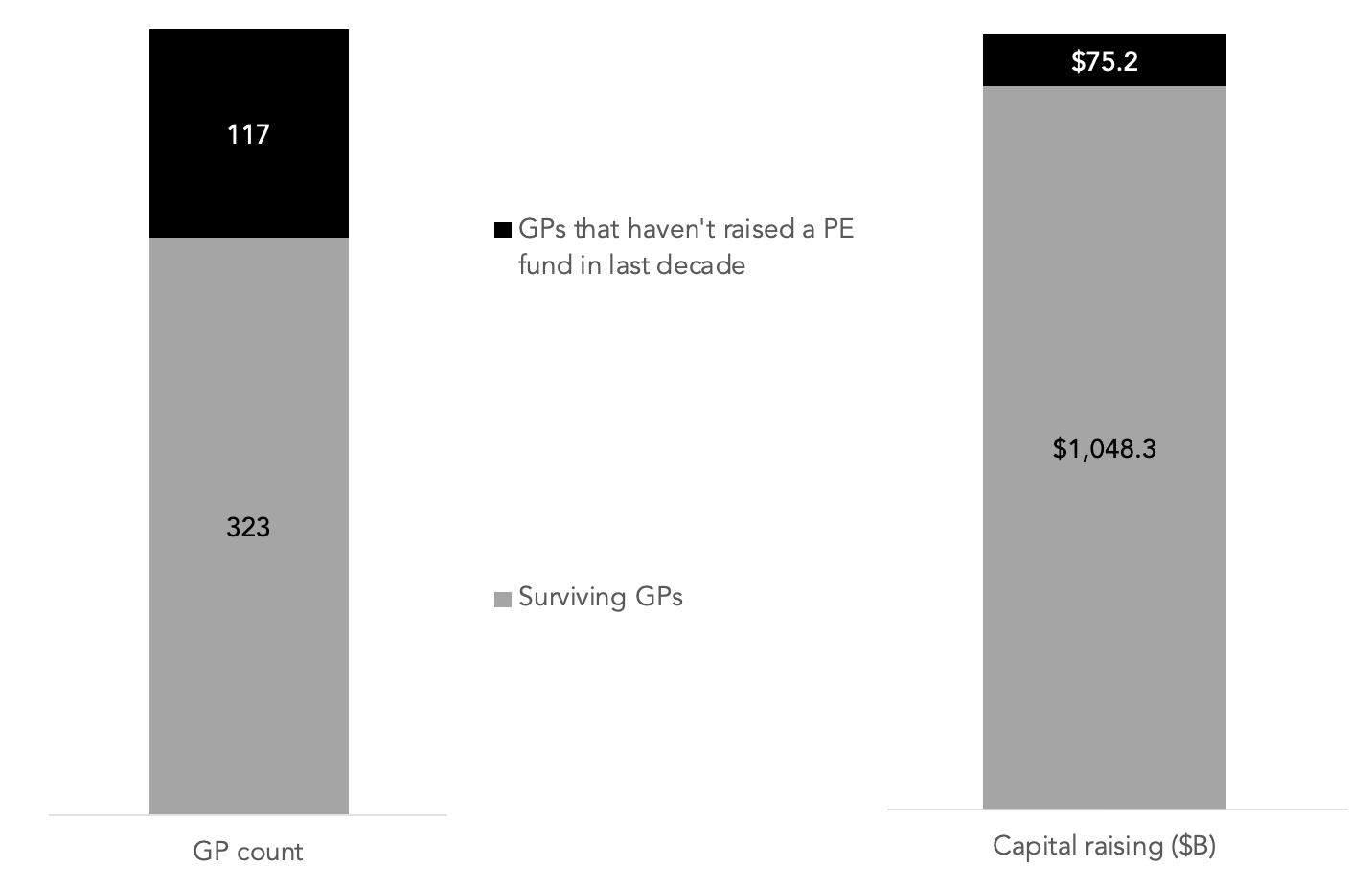
Consolidation around larger, multi-strategy firms will provide a cushion for the industry, according to PitchBook’s Quantitative Perspectives Report. The haves may become have-mores when all is said and done—consider the 2008 experience for PE firm survival rates. The chart above shows that 73.4% of investors that were active pre-GFC raised at least one fund since that crisis, but the remaining 26.5% have faded away. Reasons vary for winding down, but many of them are likely rooted in poor performance. The PE industry as a whole survived relatively intact, but lots of individual funds—and firms—were crippled by losses.
It’s relatively easy to find opportunities in a downturn—it’s much harder to keep current investments healthy and primed for exit once the storm passes. Smaller firms tend to have a tougher time given their more limited resources; they often lack the back-office resources and larger investment teams that come in handy when several fires have to be put out simultaneously. Smaller investors were more vulnerable during the 2008 financial crisis, which is worth keeping in mind amidst a new downturn that is wreaking havoc on smaller businesses.


Latest news

Share of PE middle-market deal count by backing type
Add-ons remain the workhorse for middle-market deployment, accounting for 67. 1% of all middle-market transactions YTD, in line with activity seen in recent years.

Software deal share falls in middle markets, rises in large caps
In Q3’26 software’s share of total deals fell in both the Lower Middle Market (to 7%) and Upper Middle Market (to 9%), while Large Cap saw a modest uptick in share to 8%.

Secondary loan prices stabilize following steep declines
Secondary loan prices came under significant pressure through September and October, with the Bloomberg U.S. Leveraged Loan Index declining 119…