



Download PitchBook’s report here.
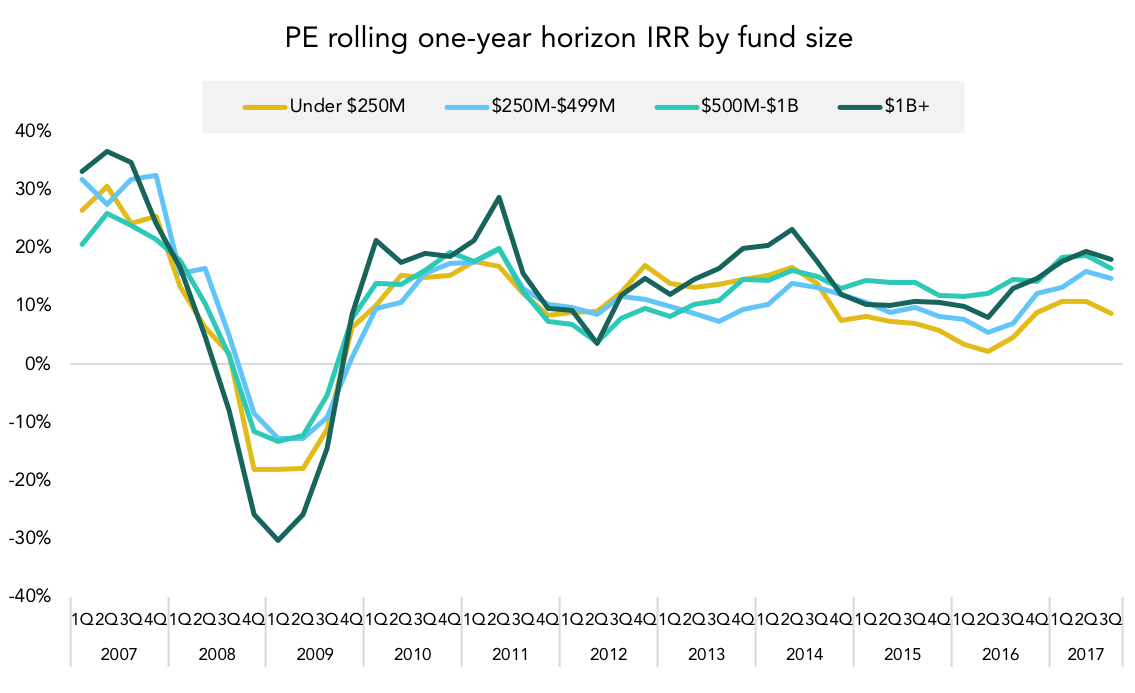
Another quarter, another round of outperformance for large funds. Rolling one-year horizon IRRs have been consistent of late when broken down by fund size, and $1B+ PE funds once again bested their smaller peers in recent returns. Much of that recent outperformance might be traced back to mark-to-market gains, which have helped boost private market comparables. Larger funds tend to hold larger portfolio companies that are more closely related in size to public companies. Those fund managers are then able to more aggressively mark up their current portfolios in tandem with the rise in public equities. On the other hand, smaller funds with less than $250M have lagged their peers. Since 2010, sub-$250M funds have outperformed the other three size buckets in only four quarters, and all consecutively between 2Q 2012 and 1Q 2013. Their recent streak is less compelling, underperforming all other size buckets for 12 straight quarters (and counting).
How far should we look into this? Perhaps not too far—deciphering trends in PE fund performance can be like nailing jello to the wall. Even general findings of persistence require caveats and asterisks. This particular study is of shorter-term, rolling returns and is not representative of the life of the fund. Other academic studies have found outperformance from smaller funds against their larger counterparts. Wherever the truth lies, recent performance impacts perception, especially when LPs re-up their commitments. The fact that larger funds are currently outperforming their peers only adds to the pile of reasons for the recent success of large fundraises and the relative difficulty of smaller fundraises. LPs continue to consolidate the number of relationships they manage with private equity GPs. That favors larger funds, which are happy to take in larger dollops of capital as a result. A 2017 survey by Palico underscored the trend, finding almost half (47%) of surveyed LPs were willing to “target lower performance if an opportunity permits an exceptionally large investment.” Time will tell if that’s a wise tradeoff, but at least some slices of data suggest there isn’t much of a tradeoff at the moment.


Latest news

Share of PE middle-market deal count by backing type
Add-ons remain the workhorse for middle-market deployment, accounting for 67. 1% of all middle-market transactions YTD, in line with activity seen in recent years.

Software deal share falls in middle markets, rises in large caps
In Q3’26 software’s share of total deals fell in both the Lower Middle Market (to 7%) and Upper Middle Market (to 9%), while Large Cap saw a modest uptick in share to 8%.

Secondary loan prices stabilize following steep declines
Secondary loan prices came under significant pressure through September and October, with the Bloomberg U.S. Leveraged Loan Index declining 119…