
The word “zombie” traces to Haitian folklore and entered the English language in the early 1800s. Americans got their first real taste through William Seabrook’s 1929 book The Magic Island and the 1932 film White Zombie. But it took George Romero to create the modern version. In 1968, he shot Night of the Living Dead, and his undead were slow, relentless, and very hard to kill. Today we’d call them zombies, even though the word was never spoken in the film.
Private equity has its own undead. They are portfolio companies that are still operating and solvent but have no credible path to its targeted return or timely exit. Along with the 2021 vintage, zombies are another tailwind for capital solutions.
Zombies are easy to spot. Holding periods have stretched. Earnings growth has stalled. Leverage is elevated, and PIK is often part of the diet. Not surprisingly, buyers aren’t lining up.
The horde is large. According to PitchBook, there are 13,509 PE-backed companies in U.S. sponsor portfolios. Roughly one-third have been held for more than five years, and more than 2,500 have outlived the traditional exit window (see Chart). The middle market also isn’t spared. About one-third of its 6,400 PE-backed companies have been held for five years or longer.
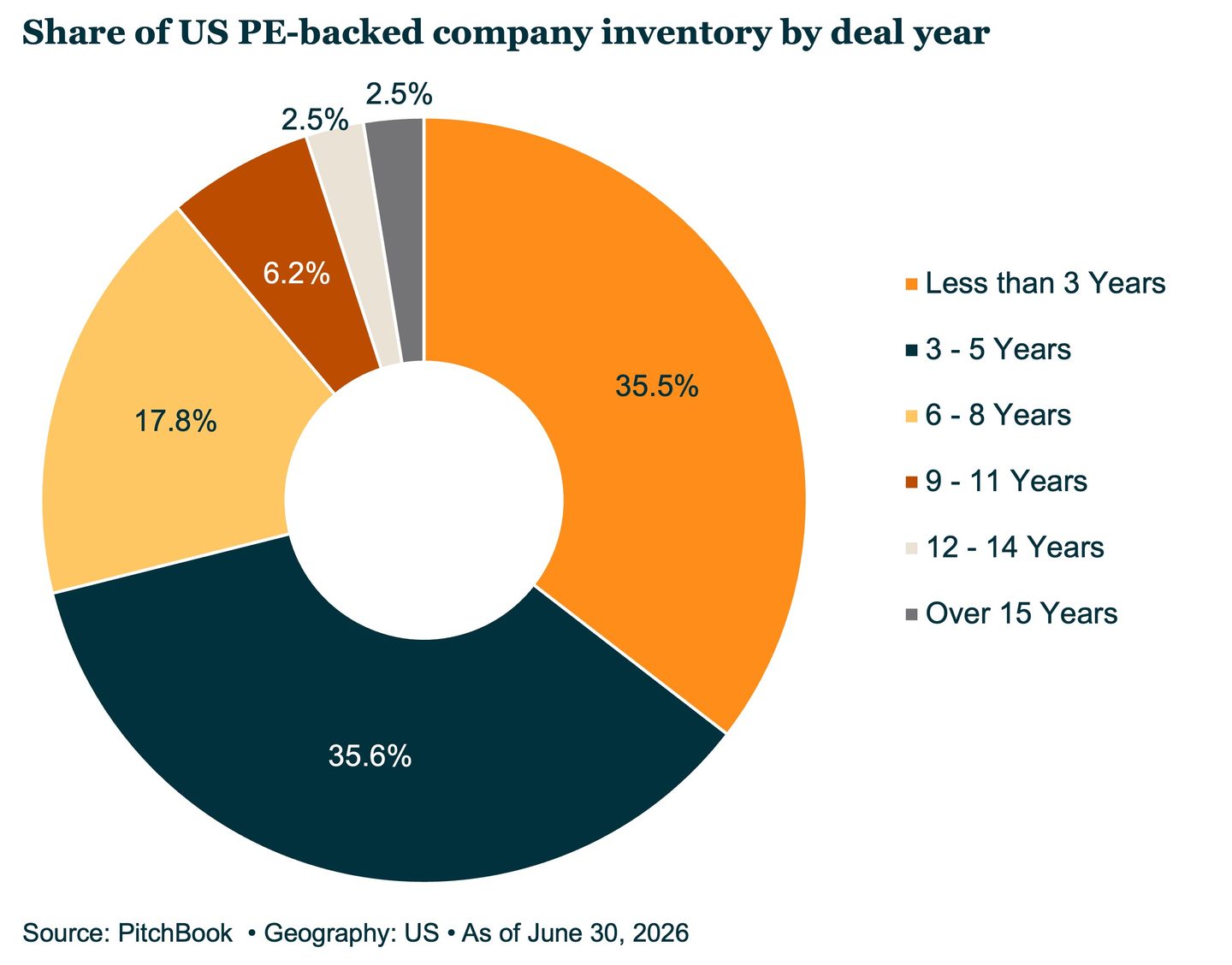
These companies aren’t necessarily distressed, but they do trap capital. By our estimates, roughly $219 billion of debt sits on middle market PE deals held for three to eight years. At the younger end of the horde, three to five years, about 20% of the $146 billion faces a complex refinancing. At the older end, six to eight years, roughly half of the $73 billion is effectively stuck. That’s $66 billion with nowhere obvious to go. Sponsors can’t exit, LPs wait on distributions, and the recycling engine that keeps private equity running slows down.
But there’s a silver lining. Middle market businesses give sponsors more levers to pull than their large-cap peers. Think pricing, cost structure, and management upgrades. They also come in at lower valuations. Middle market buyouts have historically been priced one to two turns of EBITDA below larger deals. That doesn’t make them zombie-proof, but it gives sponsors more room to generate returns through operational grit rather than multiple expansion.
That’s where capital solutions comes in. Sponsors need time and fresh capital to fund add-ons, recapitalize PIK-heavy structures, or bridge to an exit without forcing a sale. Capital solutions can provide it from the top of the capital stack, with real protections to good companies that simply need more runway.
This is no zombie apocalypse. Most of these companies aren’t failing. They’ve simply outgrown their capital structure and outlasted their hold periods. Romero’s zombies couldn’t be cured. Some PE zombies can. When traditional lenders shy away from complexity, capital solutions can step in. The goal isn’t to raise the dead. It’s to get these companies walking toward an exit.

Latest news


US leveraged loan primary market stalls in 4Q26
Primary market activity in the US leveraged loan market has slowed sharply in the fourth quarter. Just $34.9b of new…